• 39 New London Turnpike Suite 120 Glastonbury, CT 06033

VISIT US:

Concussions with Persisting Symptoms Caused by Motor Vehicle Crashes

motor vehicle concussions glastonbury ct

Analysis of Concussions with Persisting Symptoms Caused by Motor Vehicle Crashes in 136 Vehicle Occupants Shows that Females Are Vulnerable Road Users

Journal of Neurotrauma

June 2025; Vol. 42; No. 11-12; pp. 916–928

Charles H. Tator, Olivia F.T. Scott, Benjamin S. Elkin, Emma Prentice, Umar Muhammad, Mozhgan Khodadadi, Qixuan Li, Ella Huszti, Maria Carmela Tartaglia; from the Division of Neurosurgery, Canadian Concussion Centre, Toronto Western Hospital and University of Toronto. This study cites 36 references.

C+PCS = concussion plus persisting concussion symptoms
MVC = motor vehicle collision

“The objective of the present study was to identify strategies for preventing concussion among vehicle occupants involved in MVC.”

“This is the first study focused on C+PCS in MVC occupants, and our main purpose was to evaluate the effectiveness of onboard concussion prevention strategies.” All patients sustained C+PCS in a MVC with at least one symptom.

A consecutive cohort of 136 patients with C+PCS were assessed for injury in relation to the nature of the MVC including speed, direction of impact, and availability, deployment, and effectiveness of onboard occupant safety measures including seatbelts, head restraints, and airbags.

At the Canadian Concussion Centre, the authors treated 136 patients who sustained concussion plus persisting concussion symptoms (C+PCS) in motor vehicle crashes (MVCs). “This center specializes in the treatment of patients with C+PCS.”

KEY POINTS FROM THIS ARTICLE:

1) “Blunt force trauma is the leading cause of death for motor vehicle occupants with head injury being the most common lethal event.”

2) “MVC is a leading cause of all types of brain injury including concussion.”

3) “Previously, whiplash received greater attention than concussion, and older literature on whiplash did not even consider differentiating between whiplash and concussion.”

4) “Although most concussed patients recover within one month, many will have long-term deficits that interfere with return to work, school, or play and remain symptomatic from C+PCS for months or years.” [Important]

5) “Rear-end collision is the highest risk for whiplash.” [Important]

6) “Concussion after MVC has emerged as a major public health problem in many countries due to its high incidence and prolonged disability.” [Important]

7) “Most concussed patients fully recover from concussions within about one month, and those who do not recover within this time are considered to have persisting concussion symptoms (PCS), which we designate as concussion plus PCS (C+PCS).”

8) Persisting Concussion Symptoms (PCS) were defined as:

  • At least one persisting symptom
  • Persistence of symptom(s) for at least one month
  • Absence of evidence of more severe traumatic brain injury such as intracranial hemorrhage or clinical neurological defects such as limb weakness.

9) Findings:

  • The most common types of MVC were:
    • Rear-end 51%
    • Lateral 21%
    • Other 17%
    • Frontal 11%
  • “Many patients in the present study had both concussion of the brain and whiplash of the neck and were wearing seatbelts and had the head restraint in the prescribed location.”
  • “The most frequent combination of factors [for C+PCS] was a belted female driver of an automobile struck from behind by another automobile.” [Key]
  • “Most injured occupants of both sexes were wearing seatbelts, but only a minority of the crashes caused airbag deployment.”
  • “As a result of the collision, 18% experienced loss of consciousness.”
  • “Complete recovery from C+PCS caused by MVCs was low, with only 2% of patients achieving complete recovery from all PCS.” [Very Important]
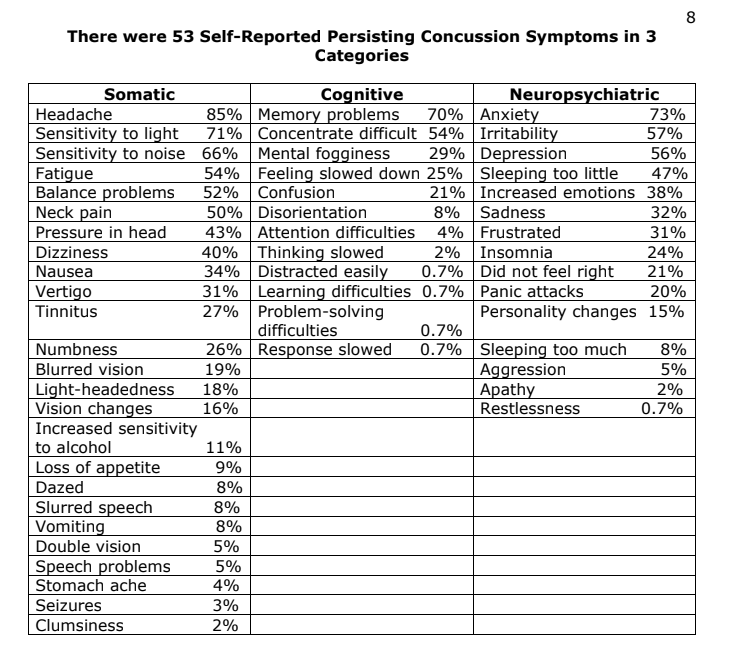
  • “Patients with C+PCS from an MVC were highly symptomatic, experiencing an average of 13 PCS distributed among the three symptom categories: somatic were most common, followed by neuropsychiatric, then cognitive.”
  • “The four types of MVCs did not differ significantly with respect to concussion recovery and symptom variables.”
  • Patients concussed in a rear-end collision had a 27% higher risk of a greater number of PCS when compared to frontal collisions.
  • Patients concussed in a lateral collision had a 36% higher risk of a greater number of PCS when compared to frontal collisions.
  • There was no association between the total number of persisting symptoms and age.

10) The 7 most common symptoms were (a complete list at end of this review):

  • Headache 85%
  • Anxiety 73%
  • Sensitivity to light 71%
  • Memory problems 70%
  • Sensitivity to noise 66%
  • Irritability 57%
  • Depression 56%

11) “Complete recovery from C+PCS was rare, and most patients with known follow-up continued to suffer from persisting symptoms for months to years.” [Key Point]

12) “The median symptom duration for all 136 patients was 30.0 months (range: 16–56 months).”

13) “In the past 20 years, there has been a remarkable reduction in the number of [MVC] fatalities …. due to the widespread adoption of seatbelts, head restraints, and airbags.”

14) “[There is] mounting evidence that females are at greater risk than males with respect to specific injuries incurred in MVC including some types of brain injury and whiplash.” [Important]

15) “The treatment offered for PCS was multidisciplinary, individualized, and symptom-oriented for managing headaches, mental health issues, dizziness, sleep disorder, and other symptoms with an emphasis on early return to physical and cognitive activity and respect for thresholds at which symptom exacerbation occurred.”

16) “Rear-end collisions were the most common type of collision, and females who sustained their concussion in a rear-end collision or lateral collision were the most prevalent group and more females were injured in rear and lateral collisions than males.”

17) “Both rear-end and lateral collisions remained significantly associated with total number of PCS when compared to patients who were concussed in a frontal collision.”

18) “In addition to concussion, many patients sustained other injuries during the MVC including whiplash, lower back injuries, and shoulder injuries.” [Important]

  • “Whiplash was the most common concurrent injury (68.6%), followed by lower back injuries (50.0%) and shoulder injuries (43.8%).” [Important]

19) Patients were asked to what extent the concussion impacted their life:

  • 50.0% indicated an “extreme amount”
  • 31% indicated “very much”
  • 14% indicated “a moderate amount”
  • 3% indicated “a little” or “not at all”

20) Airbag Deployment:

  • “Airbag deployment almost never occurred in rear-end collisions, but airbags deployed in more than half of front end and side collisions.”
  • The overall airbag deployment rate in crashes was only 29%.
    • Airbags deployed in only 5% of rear-end collisions
    • Airbags deployed in more than 50% of frontal and lateral collisions

21) Females:

  • “The typical victim was a belted female driver, often completely stopped in traffic, and then struck from behind by another vehicle.” [Important]
  • “Although more males are killed in MVC, female occupants are more likely to sustain nonfatal injuries like concussion.” [Important]
  • “Concussed female occupants were overrepresented especially as occupants in rearend collisions.”
  • “Female vehicle occupants were subject to a greater risk of sustaining concussions in frontal car collisions than males and in ‘perhaps other crash configurations.’”
  • “Reasons for the vulnerability of females to other causes of concussion such as certain sports include less well-developed neck muscles in females.”
  • “The risk of whiplash with the average female form was 1.5 times higher compared to the average male form.”
  • “When appropriate female forms were used for whiplash studies, females were significantly less protected than males.”
    • “It is highly likely that this same susceptibility applies to brain injuries such as concussion since the mechanisms of whiplash injury and concussion are very similar.” [Very Important]
  • “Females had a 14% higher risk of having a greater number of PCS when compared to males.”

22) Although considerable effort has been made to reduce deaths with prevention strategies such as seatbelts and airbags, this study shows that MVCs continue to cause many concussions among occupants involved in MVC. [Key Point]

23) “At the moment of the rear-end collision, victims often reported ‘the bobble-head effect’ of their head initially moving backward and striking the head restraint and then recoiling forward, often striking other parts of the automobile such as the steering wheel, dashboard, window, or seatback depending on occupant location.”

24) “Only 3 of the 136 participants in our study reported complete recovery with an average follow-up duration of 30 months, and those with incomplete recovery suffered prolonged symptom duration.”

25) “Concussions sustained in MVCs are associated with worse outcome compared to other causes of concussion.” [Important] Explanations for this include:

  • The greater forces applied to the head in MVCs compared to other causes of concussion.
  • The additional psychological stress in MVCs.
  • The presence of additional injuries such as whiplash.
  • “[There is a] high incidence of depression, anxiety, and diminished quality of life after concussions of all causes that can indeed prolong recovery.”

26) “When the seat configuration failed to restrain the head after a rear-end MVC, the patient could sustain a mechanical insult to the brain.”

  • “Rear-end collisions have the highest incidence of whiplash.” [Important]

27) “We found that concussions caused by MVC produced a median number of 11 concussion symptoms per patient, which was significantly higher than all the other causes of concussion.” [Very Important]

  • The total symptoms per patient averaged 13.
  • “In the present study, only four patients had less than three symptoms.”

28) “In contrast to the problems of concussions among occupants of MVC on streets and highways, it is of interest to consider the success of the automobile racing community in engineering race car cockpits and driver harnesses to protect its drivers from head and neck injuries due to the bobble-head phenomenon in all types of collisions.”

  • “The Hubbard Head and Neck Support System device and surround cockpit protection have been remarkably successful in immobilizing the driver’s head on the trunk and preventing it from moving in any direction after a crash thus saving lives and preventing brain and cervical spine injuries in motor racing sports.” [Important]

29) Conclusions:

  • “There is a biomechanical link between whiplash and concussion.”
  • “[This] study is the first to identify an overrepresentation of concussed females with persisting symptoms after rear-end collisions and to show that rear-end collisions were the most common mechanism in which female occupants were injured.”
  • “[This] study shows that current occupant safety measures including seatbelts, airbag location, and indications for deployment, and head restraints are currently insufficient to prevent concussions in MVC.” [Key Point]
  • “There is an urgent need to consider additional strategies to prevent occupant concussions in MVC, especially after rear-end collisions in women.” [Important]
  • “Based on these findings, we conclude that females are indeed vulnerable road users with respect to C+PCS, and our literature search showed that there had been some previous evidence of increased injury risk of other injuries in female occupants.” [Important]
  • “Seatbelts alone are insufficient to prevent these concussions.”

30) Recommendation:

  • “We recommend that additional prevention strategies are required to reduce the post-crash acceleration–deceleration ‘bobble-head’ movement of the head on trunk causing both concussion and whiplash as has been accomplished in auto racing.”
  • “There is a need for more concussion brain injury prevention research focusing on the vulnerability of female occupants, which has not been sufficiently addressed even though the deficiency was identified many years ago.”
  • “The sex inequity of current onboard motor vehicle concussion brain injury prevention measures especially with respect to females should be addressed by governments and the automobile and insurance industries.”
  • “One of the concussion prevention strategies for women athletes is based on anthropometric sex differences in cervical spine musculature, and the remedy suggested is improved strengthening of the cervical spine muscles by measures such as isometric neck muscle exercises.”
  • “Automobile engineers, automobile manufacturers, and governments should be encouraged to improve vehicle occupant safety systems to prevent concussions with a focus on female occupants in rear-end collisions who are at high risk of concussion.”

We have reviewed these studies on this topic:

Article Review 12-16:
The Role of the Cervical Spine in Post-concussion Syndrome


Article Review 16-16:
The Relationship Between Whiplash and Concussion in Hockey


Article Review 52-18:
Concussion with Primary Impact to the Chest


Article Review 48-20:
Cervical Injury Assessments for Concussion Evaluation


Article Review 17-23:
Cervical Musculoskeletal and Sensorimotor Impairments 4 weeks to 6 Months Following Mild Traumatic Brain Injury


Article Review 29-23:
Neck Symptoms and Associated Clinical Outcomes in Patients Following Concussion

CONCUSSION SYMPTOMS glastonbury ct
Ready To Find Out More Information?
$59 New Patient Special
If you would like to schedule a new patient visit, feel free to call our office at (860) 643-8003 or, better yet, take advantage of our offer below.
Thiele Chiropractic

39 New London Turnpike Suite 120
Glastonbury, CT 06033

Trusted chiropractor in Glastonbury
HOURS
Monday
9:30 AM - 12 PM | 3 PM - 6 PM
Tuesday
3 PM - 6 PM
Wednesday
9:30 AM - 12 PM | 3 PM - 6 PM
Thursday
9:30 AM - 12 PM
Friday
CLOSED
Saturday
CLOSED
Sunday
CLOSED
LOCATIONS
Copyright © 2026 Grow Gonstead. All Rights Reserved.